1. Introduction: Unlocking the Secret of Scooter Performance
Have you ever looked at two different electric scooters and wondered why one struggles to get up a small hill while the other effortlessly flies past cars? The answer isn’t a single secret; it’s a powerful collaboration between two core components: the motor and the battery’s voltage system.
While many might focus on a scooter’s advertised top speed, true power—the kind that delivers blistering acceleration and the ability to climb steep grades—is a function of these two critical components working in harmony. This comprehensive guide will demystify the technical secrets behind a scooter’s power, explaining how motor wattage and battery voltage are the key to a truly exhilarating ride.
For a broader overview of what defines an entire class of high-performance scooters, be sure to check out our High-Power Electric Scooters: The Complete Guide.
2. The Heart of the Beast: Understanding Motor Wattage
The motor is the engine of your electric scooter. Its power is measured in watts (W), and this number is a direct indication of how much force it can produce. However, not all wattage numbers are created equal. It’s crucial to understand the difference between nominal and peak power, as well as the benefits of a dual-motor setup.
Nominal Wattage vs. Peak Wattage
- Nominal Wattage (The Workhorse): This is the sustained, continuous power output of the motor. It’s the power the motor can produce for an extended period without overheating. Think of it as the scooter’s steady, reliable strength.
- Light Commuter Scooters: Typically have a nominal wattage of 300W to 500W, sufficient for flat, urban routes.
- Mid-Range Scooters: May feature a 500W to 1000W motor, offering better performance on small hills and light acceleration.
- High-Performance Scooters: Start at 1000W nominal and can go up to 4000W or more, providing effortless speed and hill-climbing on demand.
- Peak Wattage (The Sprint): This is the maximum power the motor can generate for a short burst, typically during launch, a rapid acceleration, or when tackling a very steep incline. This number showcases the motor’s true potential for raw, explosive power. A high-performance scooter like the Teverun Fighter Supreme, for instance, can reach a staggering peak output of 8400W, providing a thrilling, instantaneous boost that makes your heart race.
The Advantage of Dual Motors
While a single, powerful motor is impressive, a dual-motor system takes performance to a new level. By having a motor in both the front and rear wheel, the scooter distributes its total power across two points of contact with the ground. This provides several key advantages:
- Superior Acceleration: The combined torque from two motors delivers a “push-you-back-in-your-seat” feeling, launching you forward much faster than a single motor.
- Better Traction and Stability: A dual-motor setup effectively provides all-wheel drive, giving you better grip on loose surfaces, wet roads, or during aggressive turns.
- Unmatched Hill-Climbing: With double the power, a dual-motor scooter can climb slopes that would be impossible for a single-motor model. It’s the difference between struggling up a hill and cruising right over it.
3. The Lifeblood: The Crucial Role of Battery Voltage
If the motor is the heart, the battery’s voltage is the “pressure” that pushes power through the entire system. Voltage (V) is the potential energy difference that allows electrical current to flow. Just as a wider pipe allows more water to flow at a given time, a higher voltage system allows more power to be delivered to the motor without building up excessive heat.
A high-voltage system is essential for achieving high speeds and peak performance. Here’s why:
The fundamental relationship between power, voltage, and current is given by the formula: Power (P) = Voltage (V) x Current (I).
If a scooter needs to draw a high amount of power, it can either do so with a low voltage and very high current, or a high voltage and lower current. A high-current system generates significantly more heat, which can damage components and lead to energy loss. A high-voltage system is far more efficient at delivering the same amount of power, minimizing heat and improving overall performance.
According to a study published in the IEEE Journal of Emerging and Selected Topics in Power Electronics,”higher battery voltage improves system efficiency by reducing the required current for a given power output, thus minimizing resistive losses and improving thermal management.” This is why performance scooters utilize 60V, 72V, or even 84V battery systems, compared to the 36V-48V systems found in most standard models.
4. The Synergy: The Perfect Collaboration
The true magic happens when a powerful motor is perfectly paired with a high-voltage battery system and managed by a sophisticated controller. It’s a symbiotic relationship where each component enables the other to perform at its best.
The Controller: The Brain of the Scooter
The controller is a sophisticated electronic unit that manages the flow of power from the battery to the motor. It’s the “brain” that receives your throttle input and tells the motor how much power to output. A cheap, low-amp controller can bottleneck even the most powerful motor and high-voltage battery. High-end scooters use advanced controllers that can handle a massive current, unlocking the motor’s full potential for a seamless, powerful, and efficient ride.
The Dangers of an Unbalanced System
An improper pairing of components can lead to a number of problems that compromise performance and safety:
- Bottlenecked Performance: A low-voltage battery or a low-quality controller simply cannot provide the power that a high-wattage motor demands. The motor will never reach its advertised peak power, leaving you with a scooter that feels underpowered and sluggish.
- Overheating: When a system struggles to deliver power efficiently, it generates excessive heat. This can cause the motor, controller, and even the battery to overheat, leading to reduced performance and potential component damage.
- Reduced Efficiency: Energy is lost as heat instead of being converted into motion, shortening your range and making the ride less enjoyable.
5. Beyond Power: The Complete Performance Picture
While motors and voltage are the core of a powerful scooter, they are just part of the overall performance equation. For a truly high-end experience, these power components must be supported by a robust build and premium features.
- Advanced Suspension Systems: A high-power scooter can reach speeds and ride on terrain that would overwhelm a basic suspension. Look for scooters with hydraulic or adjustable air suspension in both the front and rear to handle bumps and provide a smooth, controlled ride at all times.
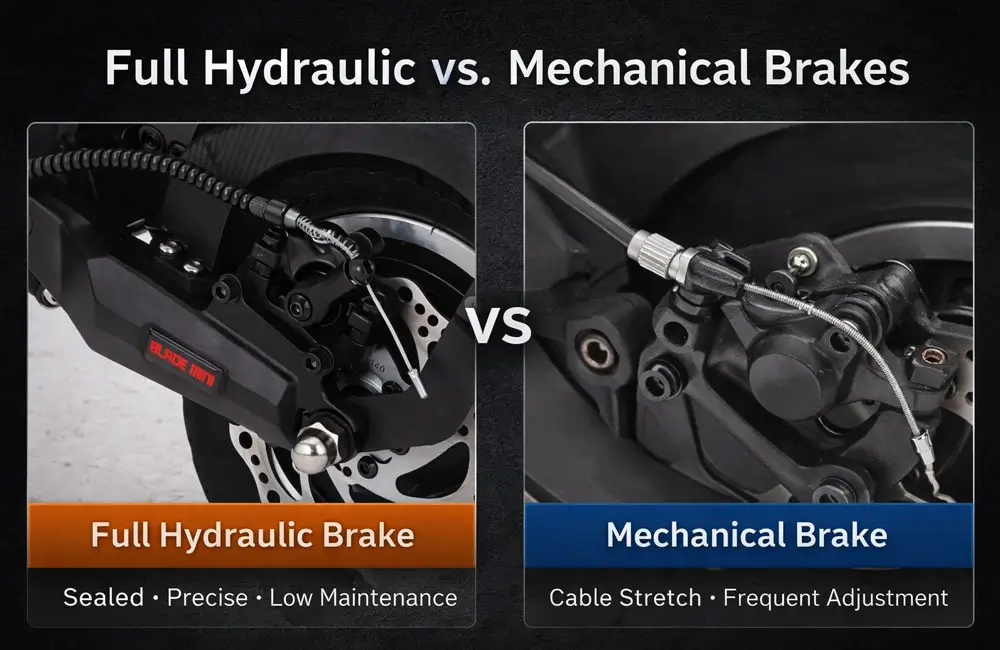
- High-Performance Brakes: With great power comes the need for great stopping power. At speeds of 40 mph or more, you need a braking system you can trust. Hydraulic disc brakes are a must-have on high-power scooters, offering superior stopping force, modulation, and a more responsive feel than mechanical brakes.
- Tires: Your tires are your only contact with the ground. For high-speed and off-road riding, wider, high-quality pneumatic tires with a good tread pattern are essential for providing the grip and stability needed to handle the scooter’s immense power.
6. Is a High-Power Scooter Right for You?
Choosing a high-power scooter is a significant decision. To help you decide, here are some questions to ask yourself:
- What Are My Primary Riding Needs? Do you need to tackle steep hills, navigate uneven trails, or simply get a thrilling, high-speed commute?
- What Is My Budget? High-performance scooters are an investment. Expect to pay anywhere from $1,500 to over $4,000, with the price reflecting the quality of motors, battery, and safety features.
- What Are My Local Laws? Regulations on electric scooters vary widely by city, state, and country. Always research local speed limits and requirements for scooters before you buy.
- Am I Prepared for the Weight? High-power scooters are heavy, often weighing over 80 lbs. Consider if you’ll need to carry it up stairs or load it into a car.
- Is the Brand Reputable? A powerful scooter is a complex piece of machinery. You want to buy from a brand that offers reliable customer service, accessible replacement parts, and a solid warranty.
7. Conclusion: The Power and the Thrill
High-power electric scooters represent the pinnacle of personal electric mobility. They are not just toys; they are sophisticated vehicles that offer unmatched performance, versatility, and fun. By understanding the core technology—from the wattage of the motor to the voltage of the battery—you can make an informed decision and find a scooter that not only meets your needs but exceeds your expectations.
If you’re ready to experience the next level of electric mobility, a high-power scooter is waiting for you. Dive into our product lineup to explore models like the Teverun Fighter series, and discover why we are a leader in the high-performance market.