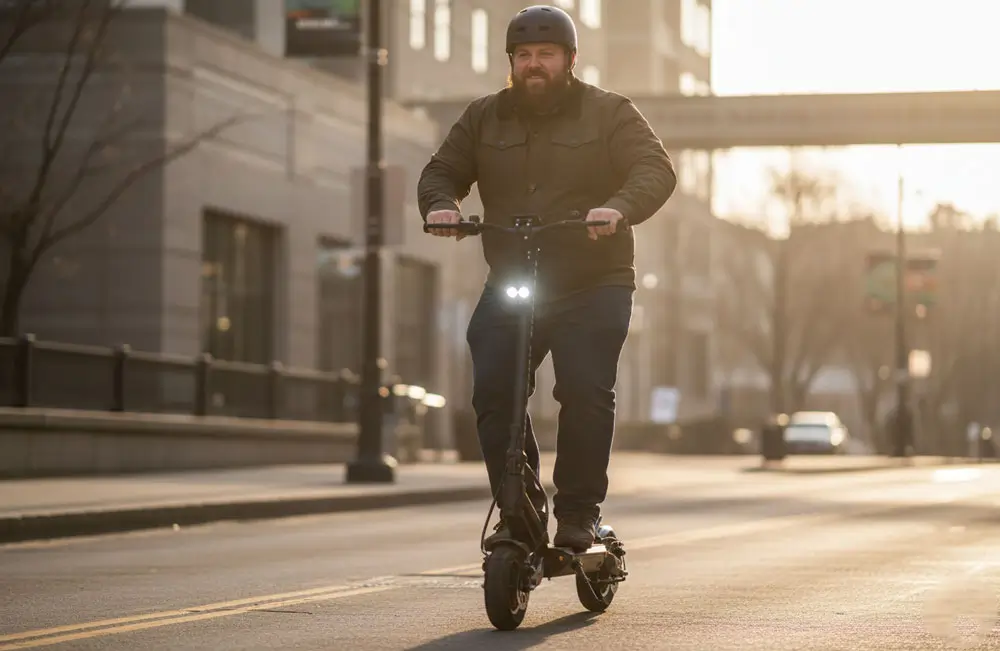
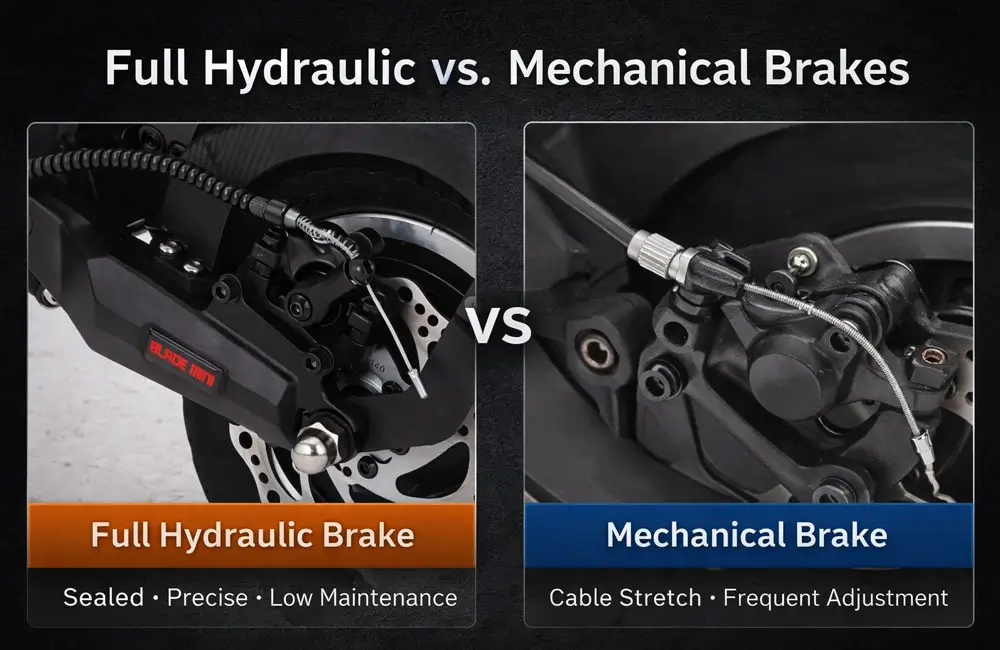
In the fast-paced world of electric micro-mobility, few brands have dared to travel the path from being a high-performance manufacturer to a design-led technology house. TEVERUN is the exception. Since its inception in 2017, the brand has been on a relentless journey of evolution. To look at the transition from the BLADE series to the SPACE is to witness the maturation of a philosophy: moving from the raw, mechanical dominance required to conquer the road, to the refined, “Cyber-Minimalist” poetry required to master the city.
1. The Genesis: Blade and the Era of Functional Ruggedness
The BLADE series—represented by icons like the BLADE GT II and MINI Pro—was born from a singular mission: “Driven by Technology, Built with Precision.” In the early years, the urban rider’s primary concern was reliability and “unfiltered” power. The design philosophy of the Blade era was one of Functional Ruggedness.
The Blade was a “Wolf in a Suit.” It introduced the industry to the concept of the integrated steering damper and the sheer energy of dual-motor balancing. Its design language spoke through exposed bolts, aggressive silhouettes, and a focus on mechanical transparency. It was a tool for the “Urban Hero”—someone who needed a rugged, high-speed machine that prioritized stability over subtlety. During this era, TEVERUN proved its “Core Authority” over the journey, establishing a bedrock of quality that could withstand over 50,000 stress tests.
2. The Awakening: Sensing the Emotional Shift of the Urban Rider
As the landscape of global cities changed, so did the rider. By 2025, the “Urban Minimalist” emerged—a rider who valued the journey’s aesthetic as much as its efficiency. TEVERUN’s R&D, moving beyond its OEM roots (like the early BLADEX), began to ask: Can a scooter be an expression of identity? Can design reduce the uncertainty of daily machinery?
The data from our competitive analysis revealed a market filled with “toy-like” designs that lacked professional finish. The transition began with a shift toward Systemic Integration. We saw the introduction of the LUMINA system and the Smart BMS 2.0, technologies that started to hide the complexity of the machine behind a veil of intelligent interaction. The philosophy was no longer just about “how fast,” but “how it feels to command.”
3. The Pinnacle: SPACE and the Rise of Cyber Minimalism
The arrival of the TEVERUN SPACE marks the definitive leap into the future. It is the “Ultimate Answer in Industrial Design”—a concept we define as Cyber Minimalism.
Where the Blade was transparent about its power, the SPACE is a “Moving Piece of Industrial Art” that holds its power in reserve. The design philosophy has evolved into a pursuit of the Seamless:
- The Art of the Fold: The folding mechanism is no longer a separate part; it’s a kinetic sculpture precisely milled to $\pm 0.05$mm tolerances, hiding the IP67-standard waterproof charging ports.
- Light as a Language: With the SPACE, illumination moved from a safety function to a “Digital Signature.” The 32 individually addressable LEDs allow the rider to communicate their mood to the city, turning a commute into a social interaction.
- Internal Beauty: Following the lead of the System V2.0 architecture, the “bird’s nest” of wiring is gone, replaced by a clean, professional internal routing that reflects a mindset of total control.
4. Comparison: A Study in Differences

Comparing the BLADE GT II to the SPACE Standard reveals the depth of this evolution. While the Blade uses its 11-inch tires and 4900W peak power to project an image of “All-Terrain Versatility,” the SPACE uses its 2400W and minimalist frame to project “Urban Sophistication.”
The Blade is the “Classic Formula”—tried, tested, and powerful. The SPACE is the “Modern Poem”—verified, smart, and beautiful. In our TEVERUN Models analysis, we see that while the hardware remains elite in both, the presentation of that hardware has moved from the external to the internal. The SPACE doesn’t need to look rugged to be reliable; its reliability is baked into its “Cyber-Minimalist” soul.
Conclusion: Future-Casting the Urban Journey
The evolution from Blade to SPACE is the story of TEVERUN growing up alongside its riders. We have moved from providing a “rugged tool” to providing a “smart companion.” As we look toward the future of urbanism, our design philosophy remains committed to the urban rider’s necessity for art and core authority.
Today, TEVERUN stands at the intersection of technical certainty and aesthetic emotion. Whether you ride the classic power of a Blade or the minimalist future of a SPACE, you are part of a lineage that refuses to settle. The journey is no longer just about reaching the destination; it’s about the silent, luminous, and mastered experience of the city itself.